

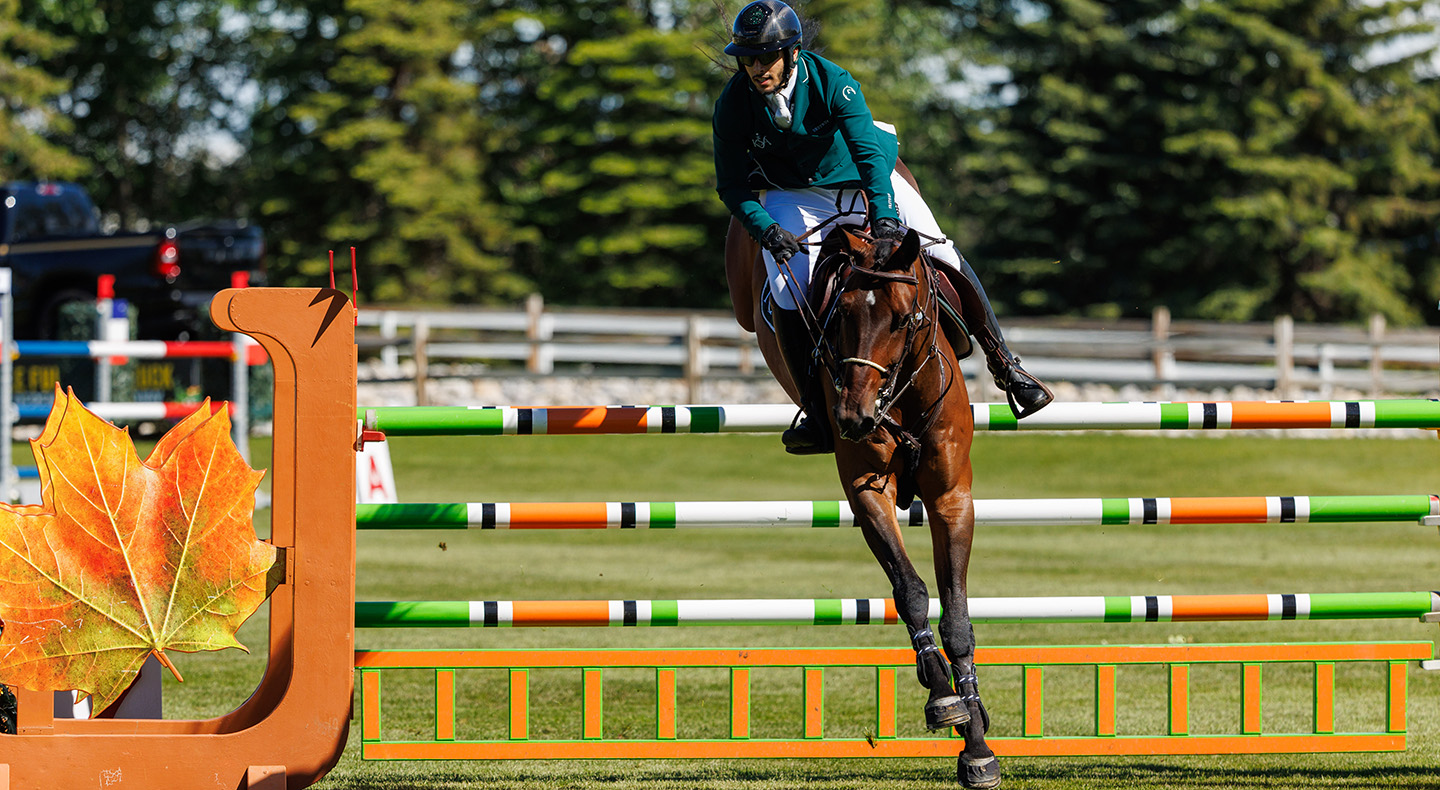
ABDULRAHMAN ALRAJHI: FAITH, FAMILY & FIVE-STAR ARENAS


(No part of this article may be copied or reproduced in any form without the permission of HT)
BLENDING THE SHARP PRECISION OF EXECUTIVE LEADERSHIP WITH THE ADRENALINE OF WORLD-CLASS SHOWJUMPING, ABDULRAHMAN ALRAJHI APPROACHES A 1.60M OXER MUCH LIKE A HIGH-STAKES BOARD MEETING; WITH METICULOUS PLANNING, QUIET COMPOSURE, AND ABSOLUTE FOCUS. BALANCING HIS ROLE AS CHAIRMAN ACROSS VARIOUS CORPORATE VENTURES WITH THE UNRELENTING CIRCUIT OF INTERNATIONAL EQUESTRIAN SPORT, ONE OF SAUDI ARABIA'S TRULY STANDOUT RIDERS MAKES CROSS-CONTINENTAL TRAVEL LOOK EFFORTLESS WHILE KEEPING HIS FEET FIRMLY ON THE GROUND.
FRESH OFF A CELEBRATED ACHIEVEMENT AT SPRUCE MEADOWS AND VALKENSWAARD SETTING HIS SIGHTS FIRMLY ON THE FEI WORLD EQUESTRIAN CHAMPIONSHIPS IN AACHEN, HE SPEAKS WITH HORSE TIMES AND DISCUSSES FAMILY LEGACY, THE REALITY BEHIND THE GLAMOUR, AND WHY TRUE SUCCESS MEANS RESETTING TO ZERO THE MOMENT THE CELEBRATION ENDS.
1. You hail from a business-oriented and philanthropic family: did this background help you in any way as an athlete?
My background coming from a business family definitely helped me a lot to become who and what I am today. Both business and professional high-level sport require similar tools, applied perhaps in different ways, but ultimately serving the same purpose. You need discipline, hard work, planning, and education, the same essential tools needed to be successful either in business or in anything else.
I think that has helped me immensely, and I owe my family, especially my father, a great deal of appreciation for what he taught me. It has helped me navigate so many situations and taught me how to be patient, organised, and disciplined. Above all, it taught me that sport, much like business, requires you to work today to get results tomorrow, not today.
2. Do you have any interests in business ventures?
I do. It is in my genes and in my blood, so I naturally grew up with it. I am still very much involved in business; I serve as Chairman for several companies and sit on the Boards of many others. I am also a Chairman and Board member for a number of charities. I am practicing what my family taught me: how to navigate the business world, how to engage in philanthropy, and how to be an asset to your community, your people, and your country. Even though sport takes up most of my time, I still manage to organise my schedule between work, business, riding, family, friends, and everything else.
3. Did you attend university? And do you feel that higher forms of education impact athletes?
I studied business management in England, and yes, I definitely believe education is crucial. It can be just as important as talent because it teaches you the essential facts of life. While some people may have a natural instinct, education teaches you how to be responsible, how to deal with difficult situations, and how to stay disciplined, organised, and creative. It equips you with traits that make you a better person both in life and in your sport. Education is definitely something we all need in our lives.
4. Do you have a mental coach?
I do not have a mental coach. I believe that reading the Quran and staying close to God is the true key.
5. How do you control your performance at events with stress involved?
Managing stress is a broad topic, and it depends on what kind of stress you are facing. But if we are talking about the stress of being in the arena at a major show, the simplest way to describe it is like the first time you sit in the driver's seat of a car. Naturally, the first time is extremely nerve-wracking and stressful because you do not want to make mistakes. But with practice, it becomes easier and easier.
That is exactly how sport works: the more you compete and practice, the less stress you feel. While I might get an extra rush of adrenaline at different shows and feel more excited or motivated at one event over another, I do not get stressed, nervous, or feel lost. I treat every show as just a new event where I do my best, and the horse does its job. Naturally, we make mistakes sometimes, but we learn from them and move on.
That is the mindset we need to keep in the back of our heads, as it applies to life in general. We make mistakes every day, but the most important thing is to learn from them and try to avoid repeating them. Making mistakes is actually vital; without them, we would never learn. So, we keep going, learn from our missteps, and through practice, lose the fear of competition. Of course, major championships like the Olympics or World Championships bring a different level of stress, but we still must treat them like any other show.
6. Last month we saw you hopping from one continent to another between Spruce Meadows and La Baule: how long does it take for you to physically recover?
In our sport, especially with the current World Ranking format, maintaining a high rank requires competing almost every week or every second week. Naturally, one must prioritise the health and workload of the horses so as not to overuse them, which involves rotating them carefully. This schedule demands a lot of travel and flying from country to country, but we truly enjoy it, as do the horses. That is part of the fun. As for recovering from the travel and the shows, good results are the answer; a win is the best recovery there is. Whenever one comes along, we feel fully recovered.
7. Some horses are better travellers than others: what is the period for your horses to recover after travelling from Europe to North America before an event starts?
Horses are all different, but mine are accustomed to long-distance travel, so they manage very well. They can land and jump a 1.60m course the very next day without issue. Travelling does not seem to affect them because they are used to flying between the Middle East, Europe, and North America. Once they are accustomed to it, they do not struggle. Of course, some horses find flights more stressful than others, but I have a fantastic team that ensures all the horses travel safely and receive the necessary care to arrive at the show ready to compete the next day.
8. How do you determine when buying a horse? Is it because it might be a good one, or a horse that would suit you as a rider?
Buying horses is a crucial aspect of our sport. To be a top rider, you must be able to select the right horses, develop and produce them, and maintain them into their older age. That, to me, is true horsemanship. Personally, I always look for a good horse; a good horse is simply a good horse, and a skilled rider should be able to adapt to all kinds of horses.
9. Give us a brief overview of your fitness programme?
I always strive to stay as fit as possible, keeping in mind the heavy travel schedule, which takes up a lot of time and energy alongside riding, recovery, and sleep. It is a lot to balance, but I rarely take a day off. If I am not riding, I am working out in the gym. I consistently aim to maintain my fitness and balance riding, gym workouts, running, and proper recovery.
10. You are admired and an icon to many young Saudi showjumping riders; how do you feel about that?
It is definitely a heavy weight on my shoulders to be seen as an icon. That is why I view everyone who looks up to me as a brother or sister; I want to ensure I convey the right image and serve as a positive role model. While it is a big responsibility, it also fills me with pride and motivates me to set the best possible example.
11. What is the biggest misconception people have about you?
That things came easily to me. I am not at the finish line yet, but one day I will write a book detailing the obstacles I have faced. There were many stones in my path, though now is not the time to dwell on them. I do not blame people for only seeing the smiles and the success, as they do not see what happens behind the scenes. For now, we remain positive and focus on the good things, but one day I will share the full story.
12. What is the one unwritten rule or ritual between you and your groom right before you enter a 5* arena?
We have many routines, but the main rule is this: if we enjoy a big win today, we celebrate it today, but tomorrow we start humble and back at zero. We do not let it go to our heads or over-celebrate, because that is how you lose focus for the next day. We reset immediately.
13. What is one rule about showjumping that you would like to cancel, and one that you would like to keep?
I am actually content with all the rules as they stand. They would not exist if they were not necessary. Every rule in our sport has been established over decades through the efforts of those who have built and developed showjumping over the past century. We appreciate what they have created and hope to build upon that legacy. While some rules are challenging, that is simply part of the sport, and we are here to embrace those challenges.
14. We’ve noticed you love action sports like skiing; what other sports do you love and practise besides that and showjumping?
I am a huge sports enthusiast in general. I may not watch many sports on TV due to a lack of time, though I will happily watch a match with friends. I love playing almost anything. I enjoy padel and football, though I have stopped playing football for safety reasons to avoid injuries while competing professionally.
I love basketball, bowling, and especially volleyball, which is probably my favourite. I dislike sitting idle, so if it were up to me, I would be active all day moving from one sport to another. I have also taken up golf over the last few years, and I absolutely love it, even if time constraints prevent me from playing as often as I would like. Overall, my favourites alongside showjumping would definitely be volleyball, golf, padel, and bowling.
15. Congratulations on your amazing win at Spruce Meadows; how did the win feel?
Every win is extremely valuable to me, whether it is a 2* or the biggest Grand Prix of my career. I respect every victory because it never happens by accident, it takes an immense effort from my grooms, my horses, and my whole team. Winning the Queen Elizabeth II Cup was a massive milestone and an incredible feeling. It brings immense joy, but it also fuels your motivation for even bigger targets ahead. We have the World Equestrian Games coming up, so hopefully, we can carry this momentum forward.
16. What do you do after a big win? How do you treat your horse?
After a victory, you, your horse, and your groom certainly deserve to celebrate. But to maintain consistent success, you must remain humble, keep working hard, and stay focused. There is a fine line between celebrating and over-celebrating; over-celebrating can lead to a loss of drive, focus, and an unwanted ego.
We celebrate on the day, but by the next day, it is forgotten. The same applies to losing: if things go wrong, the team works to identify the issues that day, but by the next morning, we restart with fresh motivation. That is the core philosophy of how my team operates.
17. You’re selected to go to the FEI World Equestrian Championships in Aachen with three horses; tell us about your plans?
We are preparing for a major event in the World Equestrian Games, and we are doing our homework thoroughly. Our recent success at Spruce Meadows gave us a great boost of confidence and motivation, but we still have to deliver on the day.
Representing Saudi Arabia is a massive responsibility on its own, let alone at a World Championship. My team, grooms, horses, vet, farrier, and office staff are putting all their energy into ensuring we represent our country in the best possible way. HT
*Al Rajhi was born on 10 April, 1995
Photo courtesy of Spruce Meadows Media